Rome for architecture: four layers with different access rules
9 min read
In Rome you can stand inside a two-thousand-year-old concrete dome in the morning and inside a Zaha Hadid building in the afternoon. That is the reason to come here for architecture rather than for art. Plan the journey to MAXXI in Flaminio separately; it is not a short walk between neighbouring sights.
Architecture trips require separate planning for each layer: archaeological sites, churches, terraces and modern museums have different operators and visitor rules. Check each place’s own calendar.
Here is what each layer actually demands of your day.
Layer one: ancient concrete, and a closing time that changes with the season
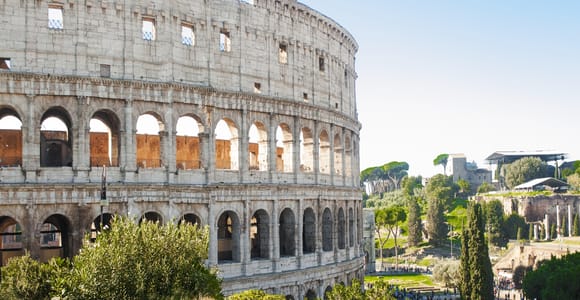
The Pantheon and the Colosseum are the two buildings that make the case. One is a dome of unreinforced concrete with a hole in the top that has stood since the 120s; the other is a machine for moving fifty thousand people, which is an engineering problem before it is a spectacle.
The Colosseum and the Forum are one archaeological park, and their hours swing further across the year than almost anything else in the city. For 2026: Official hours.
| Period | Closing | Last admission |
|---|---|---|
| 29 March – 30 September | 7.15 p.m. | 6.15 p.m. |
| 1 – 24 October | 6.30 p.m. | 5.30 p.m. |
| 25 October 2026 – 28 February 2027 | 4.30 p.m. | 3.30 p.m. |
The Colosseum opens at 8.30 a.m., the Forum and Palatine at 9 a.m. — half an hour apart, which is worth knowing if you booked a combined ticket and turned up early. Closed on 25 December 2026 and 1 January 2027.
Look at the winter row again. From the last week of October the park shuts at 4.30 p.m. with last admission at 3.30 p.m. If you are in Rome in November and you planned the Forum for “late afternoon”, you have planned it for a locked gate. The Forum is the site that suffers most from this, because it is the one that wants two unhurried hours of daylight.
We go through the ticket variants in Colosseum: entry with an audio guide, or a guided tour? and the structural reading of the site in making sense of ancient Rome. For the Pantheon’s €7 ticket and what the building is doing, see the Pantheon. Official Pantheon tariff.
Layer two: Baroque churches and their access rules
Borromini and Bernini are the reason architects come to Rome, and almost all of it is inside working churches. San Carlo alle Quattro Fontane, Sant’Andrea al Quirinale, Sant’Ivo alla Sapienza, the Gesù, Sant’Agnese in Agone on Piazza Navona.
Check each church’s own access arrangements before travelling. Worship, restoration work and visits to adjoining rooms can have different hours and ticket rules. A church on a walking route is not a guaranteed interior visit.
What that means in practice:
- Check the dates before crossing the city. For Sant’Ivo alla Sapienza, Rome’s tourism office announces reopening from 27 October 2026, Monday to Friday, 9.30 a.m. to 1.30 p.m.
- Keep alternatives on the route. Check the other churches individually; a general afternoon recommendation does not work for Sant’Ivo.
A guided walk can help you read the architecture; confirm the actual interior stops before booking. See our walking tours for the format.
If your interest is the century before this one rather than the Baroque, the buildings and the opening hours are different again — Rome for the Renaissance covers them, including the one frescoed villa that closes at 2 p.m.
Layer three: the nineteenth century, which Romans still argue about
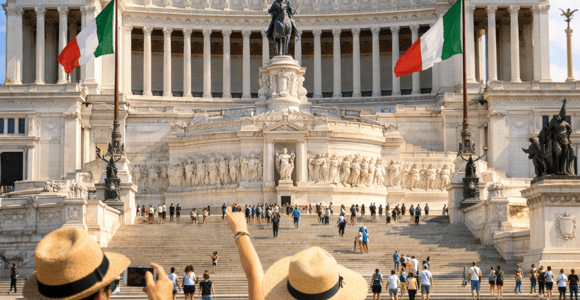
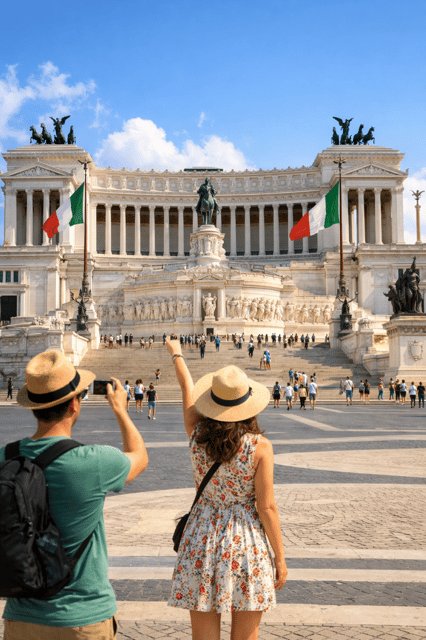
The Vittoriano — the Altare della Patria, the white mass above Piazza Venezia — was built between the 1880s and the 1930s to give a newly unified Italy a monument, and it did so by demolishing a chunk of medieval Rome to make room. Romans have called it the typewriter and the wedding cake for a century.
Go up it anyway, and go up it for the argument. The terrace gives you the one view in which the four layers of this article are visible at once: the Forum below, the Baroque domes across the roofs, and the twentieth century on the horizon. Both the terrace-entry offer (€27 per person) and Touristation’s elevator offer (€36 per person) include the panoramic elevator and Palazzo Venezia. The former is self-guided with audio, with ticket collection from a host in a green vest in Piazza d’Aracoeli. Touristation starts at Piazza d’Aracoeli 16 and excludes wheelchair users and people with mobility impairments. For step-free access, use the accessible route described by VIVE; a lift in the title alone is not enough. VIVE.
Layer four: the twentieth and twenty-first centuries, and the two tickets worth having
Museo dell’Ara Pacis, Richard Meier’s glass-and-travertine box over Augustus’s altar, finished in 2006 and the most disliked new building in the historic centre when it opened. From the museum’s own ticket page: Full €14, Reduced €8.50, and Free for residents of Rome and the metropolitan area — free for residents of Rome and the metropolitan area. A videoguide to the permanent display is €6.00 and an audioguide €4.00, both in Italian, English, French, German and Spanish. Advance purchases add €1; the resident exemption does not cover separately ticketed exhibitions. Ara Pacis.
It is the rare case where the container and the contents are both worth the ticket: a Roman altar of 9 BC inside an argument about how to build next to one.
MAXXI, Zaha Hadid’s national museum of twenty-first-century art in the Flaminio district, and the best building in Rome from the last fifty years by a wide margin. Hours: Monday closed, Tuesday to Sunday 11 a.m. – 7 p.m., also closed 1 May and 25 December. Tickets: €15 at the box office / €14 online full, €12 at the box office / €11 online reduced for ages 18 to under 25 and groups of 15 or more, and free for under-18s. MAXXI.
Two practical notes. MAXXI opens at 11 a.m. and the ticket office closes an hour before the museum. The official page currently advertises a €10 special admission from 20 October to 12 November 2026. The €18 “open” ticket is valid for a year; it is not the standard exhibition supplement. Check the ticket for the exhibition you want.
EUR, the district built for a world exhibition that the war cancelled, is another area to explore without an admission ticket. You walk it. The Palazzo della Civiltà Italiana — the square arched block on every architecture postcard of Rome — is a corporate headquarters, so treat the outside as the visit and check separately whether anything is open inside on your date.
The one decision this article exists to make
Tickets or a guide?
For layers one and four, buy tickets and skip the guide. The Colosseum, the Ara Pacis and MAXXI are all buildings that explain themselves once you know one fact about the structure, and a recording or a wall panel delivers that fact.
For layer two, choose a guide for architectural explanation and help planning the route. Confirm which interiors the tour actually includes; a guide cannot guarantee that a church will open.
For layer three, buy the terrace ticket, stand on it for twenty minutes, and look down.
When Rome is the wrong architecture trip
If you want a coherent single-period city, this is not it: Rome is layers cut into each other, and that is either the attraction or the frustration. If you have one day, the ancient centre will take all of it and you will see one layer. And if you are here in the last week of October or later, rebuild the plan around a 4.30 p.m. closing time before you book anything else.
Everything mentioned here sits in our Rome selection. For the underground layer this article leaves out, see Rome underground; for the dome that most visitors climb, St Peter’s dome; and for fitting it into the days you have, which Rome tour to book.