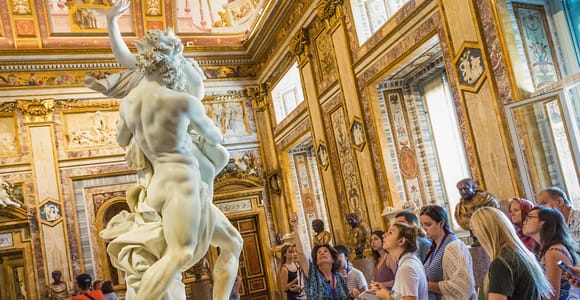
Galleria Borghese: the two-hour clock decides everything else
9 min read
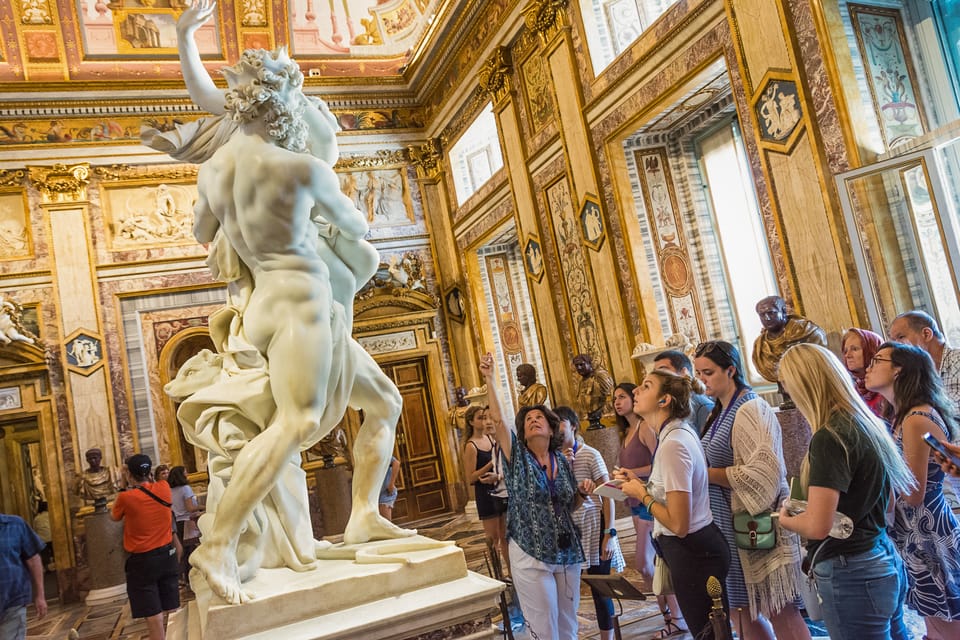
Most Rome museums sell you a right of entry. The Galleria Borghese sells you a slot, and that is a different product. You are admitted on the hour, the visit lasts two hours, and at the end of the slot you leave so that the next 180 people can come in. The choice between an audio guide and a live guide needs to fit that clock.
So start with the official numbers, because three of the four decisions follow from them.
What the gallery itself charges
From the official ticket page:
“INTERO € 16,00 (ultimo turno € 11,00)” — full price €16.00, with the last slot at €11.00.
Reduced admission: €2.00, from age 18 up to the 25th birthday, for eligible EU citizens and the equivalent categories specified by the museum; bring proof of eligibility.
“GRATUITO minori di 18 anni” — free for under-18s.
And then the line that catches people out:
Booking is compulsory for every ticket type. The usual booking fee is €2.00, but children aged 0–5, disabled visitors and one eligible companion, and certain other categories are exempt from the fee. They still need a reservation.
Read that twice. The booking fee also applies to free tickets for children aged 6–17 and to reduced youth tickets. For two adults and two twelve-year-olds at the standard tariff, the calculation is €16 + €16 + four €2 booking fees = €40, not a separate admission charge for the children.
The working total for one adult is therefore €18.00, and for the last slot €13.00. Temporary exhibitions can increase admission prices.
The slots, and why the last one is the cheap one
“I turni di ingresso al museo sono ogni ora” — entry slots are hourly.
“la visita dura due ore (ad eccezione del turno delle 17.45)” — the visit lasts two hours, except the 5.45 p.m. slot.
“Ad ogni turno possono entrare 180 persone” — 180 people per slot.
“La Galleria è aperta dal martedì alla domenica. Dalle 9.00 alle 19.00.” Closed Mondays. Last admission 5.45 p.m. The ticket desk opens at 8.30 a.m. and closes an hour before the museum. The gallery shuts on 25 December and 1 January.
The last slot starts at 5.45 p.m. and the building closes at 7 p.m.: that gives you 1 hour 15 minutes, or five eighths of a normal two-hour visit. Its standard admission is €11 plus the €2 booking fee.
Whether that is a bargain depends entirely on what you came for. For a first visit it is not enough — two floors, twenty rooms, and the Bernini sculpture groups alone will eat it. For a return visit focused on a few works, the shorter slot may be enough; quieter rooms are not guaranteed.
The first Sunday, and the trap inside it
On the first Sunday of the month, admission is free. Reservation remains compulsory, with the usual €2 fee unless you qualify for an exemption.
These tickets become available 10 days before the date. Book promptly: this is still a timed visit, and the museum does not offer last-minute tickets on free-admission days.
What platform listings add
Against an €18 counter price, the marketplace looks absurd until you separate the three things being sold.
| Offer; from, per person | Included |
|---|---|
| Entry with audio-guide app – €44 | Ticket, time slot and app on your own phone; 2 hours |
| Entry with digital audio guide – €49 | Ticket, host and digital audio guide; live guide only with that option |
| Guided tour with tickets – €49 | Ticket, art-history guide and headsets; 2 hours |
| Small-group guided tour – €72.25 | Ticket, English-speaking guide and headsets; up to 15 people, 2 hours |
| Guided gallery visit – €59.40 | Ticket and English-speaking guide; up to 15 people, 2 hours; gardens independently |
For the app ticket, bring your own phone and headphones; commentary is available in English, German, French, Italian, Portuguese and Spanish. It is advertised as wheelchair accessible. The hosted audio-guide offer excludes wheelchair users and people with mobility impairments; the art-historian tour also excludes wheelchair users. Both prohibit strollers. The art-historian tour offers Russian, English, Japanese, French and German; its meeting point depends on the option, while the other four meet at Piazzale del Museo Borghese. The recommended English-language gallery visit is advertised as wheelchair accessible. Confirm the suitable route for your needs. The app ticket excludes a live guide and headphones; the hosted audio offer and art-historian tour exclude transport, food, drinks and tips; the other small-group tour excludes tips.
Compare each selected option with the official admission-and-booking total, allowing for any exhibition surcharge. A higher price does not itself guarantee a better slot or a live guide. The museum explicitly says that it has no separate “skip-the-line” admission: everyone enters at the assigned time and may queue briefly. Marketplace wording does not override that rule.
The honest question is not whether the markup is fair. It is whether you want a person, because the two-hour clock changes that answer.
Audio guide or a person: here the answer is different
At the Pantheon we argued that a recording does most of the work, because the building explains itself once somebody tells you about the concrete. At the Borghese the opposite is true, for a structural reason.
Bernini’s groups are made to be walked around. Apollo e Dafne and the Ratto di Proserpina change completely between one side and the other, and the whole point of the marble is what happens at the moment you move. A recording tells you to look; a guide moves you. A guide can help you choose what to focus on within the fixed visit.
The upper floor, the picture gallery, works the other way. Raphael’s Deposizione and the Titians reward standing still, and standing still is what a recording is for. For a wider itinerary, see Rome for the Renaissance.
If you take a guided listing, check its route and duration before assuming that you will have time upstairs alone afterwards. The ticket’s exit time still applies.
When the Borghese is the wrong booking
Without a booking, entry is uncertain. The museum’s FAQ allows limited last-minute purchases at the ticket office from 20 minutes past each hour, for a 90-minute visit; the last release is at 5.50 p.m. for a one-hour visit. There is a limit of two tickets per purchaser, and availability is not guaranteed. This option is unavailable on free-admission days.
If you are on a half-day in Rome, the two fixed hours plus the walk in across Villa Borghese park — the gallery sits inside the park, not on a street corner — is most of your morning, and neither the Vatican nor the ancient centre fits round it.
If your party will not stay two hours, the slot still ends when it ends, but the cost per useful hour goes the wrong way fast. With younger children the 5.45 p.m. slot at €13 is the kinder arithmetic, and under-18s are free apart from their €2 booking fee. Children aged 0–5 are exempt from that fee.
If Caravaggio is your main interest, consider the Roman churches that hold his paintings as another possible itinerary. Check each church’s opening hours, visitor rules and charges before planning the visit.
The short version
Decide between audio guide and live guide before paying: both types of package can include admission, so buying a separate ticket first may mean paying twice. A guided visit is a reasonable choice for a first encounter with Bernini; choose its language, route and time slot together. If English suits you, choose the Guided gallery visit; otherwise select a suitable guide language or audio-guide package.
Everything mentioned here sits inside our Rome selection. For the same ticket-versus-guide question at a very different building, see Castel Sant’Angelo; for how the Vatican handles art with a guide, the Vatican for art lovers; and for fitting this into a wider plan, which Rome tour to book.